
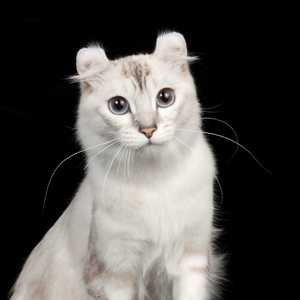
- Désignation:
- ACL
- Groupe:
- Semi longhair
- Catégorie:
- Principale
- Origine:
- USA
- C’est recommandé:
- families with children; for active but calm people; for those seeking a breed with a unique appearance; for apartment living.
The origin of the breed
This relatively young breed originates from California. In Lakewood in 1981, the Ruga couple found a stray black cat with semi-longhair fur and unusual ears: they were curled backward.
At the end of the year, Shulamith – as the cat was named – gave birth to four kittens, two of which also had curled ears. Breeders then turned their attention to this new cat, and two years later, Shulamith and her offspring were presented at a show in California.
"Curl" in English means "завиток," so the new breed was named the American Curl. The charming curled ears with thick fur are the result of a spontaneous mutation caused by a dominant gene that can be passed on by one parent. When a Curl is crossed with an ordinary cat, at least half of the kittens are typically born with curled ears. Kittens from the same litter with straight ears are called Curl-Straight and are used for breeding or sold as ordinary domestic cats.
Currently, there are two varieties of the breed, differing in coat length. The longhair American Curls appeared first. The shorthair variety took longer to develop. Shorthair American Curls carry the recessive longhair gene and often produce longhair kittens.
The breed was recognized by TICA in 1985, and in 1991 it received official recognition from CFA. At the end of the 1980s, the breed appeared in Europe. In such a short period of existence, the American Curl has gained international popularity. Today, there are many catteries of this breed in Europe, North America, and Japan. Remarkably, after the recognition of American Curls, native cats with similarly curled ears began to be found in different parts of the world, including South America and Australia.
Appearance
Not a large cat, but not small either; weight ranges from 3 to 5 kg. Sleek, proportionally built, elegant, but with a strong bone structure. Sexual dimorphism is pronounced: males are larger and stronger than females. The trademark of the American Curl is its backward-curled ears.
Standard — Point Scale (TOPCAT):
| Parameter | Points |
|---|---|
| Head (shape, muzzle, chin, profile) | 25 |
| Eyes | 10 |
| Ears (shape, curl, set) | 25 |
| Body (size, boning, musculature, torso) | 20 |
| Legs and paws | 5 |
| Tail | 5 |
| Coat (length, texture, color) | 10 |
| Condition | 5 |
| Total | 100 |
Head: Medium size, slightly elongated, wedge-shaped with smooth, rounded contours. The muzzle is neither pointed nor square, but wedge-shaped, of medium length, with soft contours and no sharp cheek boundaries. In profile, a slight rise is noticeable at the transition from the lower eyelid to the forehead. The slightly convex back of the head smoothly curves into the neck. The nose is straight. The chin is strong.
Eyes: Fairly large in proportion to the head, walnut-shaped (oval upper lid and rounded lower lid), wide-set (at least one eye's width apart), with a slight slant. The color of bright, sparkling eyes should be solid and not necessarily related to coat color. In point-colored cats, only blue eyes are permitted.
Ears: Moderately large in proportion to the head, broad and open at the base, set high and straight, with rounded tips. Curled backward toward the center of the skull. The curl angle should be at least 90 degrees. The ear tip should not touch either the back of the ear or the cat's head.
The ear curl comes in three degrees:
- Slightly curled ears
- Moderately curled ears
- The most prestigious and highly valued option – ears curled into a crescent shape
The curled portion of the ear should be smooth. The tips are flexible. Dense fur inside the ear (ear tufts) is desirable.
Neck: Medium length, muscular.
Body: Rectangular in shape, rather elongated: length is one and a half times the height at the withers. Bone structure and musculature are not overly developed but not weak either. Moderate tone and strength.
Legs: Medium length and thickness, proportional to the body, straight, with strong muscles. The front legs are slightly shorter than the hind legs.
Paws: Rounded, compact, medium-sized.
Tail: Equal to the body length, broad and thick at the base, gradually tapering to a rounded tip, fluffy.
Coat: Semi-long, not too dense and not plush to the touch, fine, delicate, silky, flowing. The undercoat is sparse and not well-developed. The ruff is not pronounced. The tail is very well-furnished.
Colors: Any colors, including colorpoint. The color should be well-defined, without flaws, and with a clear pattern (if present in the color).
Faults: Sharp transition from forehead to muzzle; dense, coarse coat with abundant undercoat; presence of a ruff; dense or plush coat; low-set ears; crimped ears; sharp bend of the ear tip instead of a soft curl.
Disqualification: Straight ears or ears with significantly different degrees of curl; extreme curl in adult cats where the ear tip touches the head or the back of the ear; stiff ear tips; ears where the lower part is abnormally flattened, the cartilage is compressed, and the ear lacks normal visible structure; tail defects.
Disqualification for all breeds: Amputated claws, cryptorchidism, deafness, noticeable bone deformities.
Personality and Character
The Curl is a cat with a balanced character and even temperament — cultured, "intelligent," yet playful and mischievous. It gets along easily with people, preferring interaction with its owner over play with its own kind, although it does not quarrel with other animals, whether other cats or even dogs.
It becomes very attached to its owner, is sociable, gentle, and affectionate. Great with children. Easily trainable. The cat is active, lively, enjoys long walks, and walks willingly on a leash.
Sexual maturity occurs at 2–3 years. The ear cartilage begins to curl and harden as early as the fourth day after birth, but the final shape is established by 3–4 months.
Care and Maintenance
Caring for an American Curl is not difficult but requires attention to the ears.
- Coat: Brushing once a week with a brush and comb is sufficient.
- Ears: The ears must be carefully monitored, as dirt and wax can accumulate in the ear due to their curled shape. Clean with a special solution.
- Bathing: The cat should be bathed a few days before a show. At other times, bathe as needed.
- Hygiene: Regular eye checks, nail trimming.
Nutrition
A balanced diet is required — super-premium food or high-quality natural nutrition. As a rule, cats of this breed are not prone to overeating and obesity.
Health
American Curls are generally a healthy breed. However, due to the open shape of the ears, there is an increased risk of infections and debris entering the ear canal. Regular ear cleaning is recommended. Life expectancy: 13–16 years.
Breeding
Permissible outcrosses (in the TOPCAT system):
- None (breeding is conducted only within the breed)
- Curl to Curl-Straight matings are permitted to maintain genetic diversity
Breeds Created Using American Curl Longhairs
- Ruffp — a rex version obtained by crossing American Curls with Cornish Rex
Other and Obsolete Breed Names
American Curly.
Unofficial (Slang) Names
Curl. American Curl.