
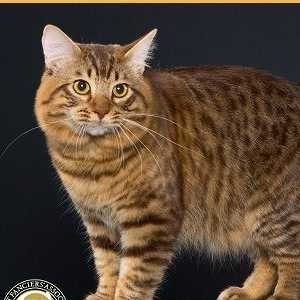
- Désignation:
- ABT
- Groupe:
- Semi longhair
- Catégorie:
- Principale
- Origine:
- USA
- C’est recommandé:
- families with children; for active, energetic people; for those seeking an unusual breed with a short tail; for living both in apartments and private homes.
The origin of the breed
The American Bobtail breed was created by breeders in the USA in the 1990s, based on short-tailed domestic cats found in the country (especially in New England). The genetic ancestors of the Bobtail are unknown. They may have been the Lynx, the Manx, or the Japanese Bobtail: litters of all these cats contain kittens with short tails or even no tails at all.
The founder of the American Bobtail breed is considered to be a tabby kitten named Yodie. In 1965, he was found near an Indian reservation in Arizona. Yodie had the habits of a wild animal and an unusually short tail. When the kitten grew up, the owners, the Sanders couple, found him a mate — a Siamese cat named Mishi. The kitten born from them, which also had a short tail, was crossed with a cream-colored cat, and this union again produced short-tailed offspring.
It then became clear that this was a mutation caused by a dominant gene — meaning it was possible to create a new breed. Felinologists Mindy Schultz and Charlotte Bentley took up this work. Thus, American Bobtails appeared in the world — at first only shorthair.
In the 1980s, successful attempts were made to create a longhair variety of the breed. It was created by crossing shorthair American Bobtails with Himalayan cats (Persian colorpoint).
The first breed standard was adopted in 1970, and in 1989 it was recognized by the first international felinological system — TICA. To this day, the breed is predominantly distributed in the USA and Canada.
Appearance
An animal of medium to large size, adult weight ranges from 3 to 9 kg. American Bobtails can be either short-legged and stocky or medium-sized — powerful, heavy, and muscular. The main distinguishing feature is the shortened tail, ending just above the level of the hocks.
Standard — Point Scale (TOPCAT):
| Parameter | Points |
|---|---|
| Head (shape, muzzle, chin, profile) | 25 |
| Eyes | 10 |
| Ears | 5 |
| Body (size, boning, musculature, torso) | 25 |
| Legs and paws | 5 |
| Tail | 15 |
| Coat (length, texture, color) | 10 |
| Condition | 5 |
| Total | 100 |
Head: Broad modified wedge shape, without noticeable flat surfaces or arches. In profile, a smooth curve is visible at the transition from forehead to nose. The nose is broad and smoothly curved. The muzzle is slightly wider than it is long, with a distinct transition to prominent cheekbones. The chin is broad and deep.
Eyes: Large, wide almond-shaped, slightly oblique, set toward the base of the ear. Developed brow ridges give these cats a somewhat "stern" expression. Eye color is unrelated to coat color, except in point, mink, and sepia colors.
Ears: Medium to moderately large, broad at the base and rounded at the tips. Set rather high and straight, continuing the line of the head wedge. Ears may appear pointed if they have "lynx tips" (ear tufts).
Neck: Medium length, muscular.
Body: Rectangular in shape, rather long, muscular. The back rises slightly toward the hips, bone structure is dense, chest is broad, the rump is almost as wide as the chest — quite powerful. Muscular and athletic in appearance.
Legs: Medium length, strong, heavy. Hind legs are noticeably longer than front legs.
Paws: Broad, round, compact.
Tail: Short, minimum length — 2.5 cm of vertebrae. Not longer than 10 cm (not reaching the hock joint). Slightly curved. This is the breed-defining feature.
Coat: Semi-long, dense, double, rather coarse to the touch, with thick, very dense guard hairs and a moderately developed undercoat. It does not lie close to the body and looks slightly shaggy, making the cat appear visually larger than it actually is. The longest hair is on the ruff and tail.
Colors: Any colors, including blue and red tabby. On point colors, "residual" body markings are desirable. Rufism in "silver" colors is acceptable.
Faults: Too short a muzzle; sharp transition from forehead to muzzle; too short (less than 2.5 cm) or too long (over 10 cm) tail; too fine bone structure.
Disqualification: Absence of a tail; tail of normal length; tail length less than 2.5 cm; fused vertebrae and immobility at the base.
Disqualification for all breeds: Amputated claws, cryptorchidism, deafness, noticeable bone deformities.
Personality and Character
Short-tailedness does not affect the health of American Bobtails: they can jump and climb excellently. The cat is very calm, patient, good-natured, and becomes very attached to its owner. It enjoys the company of other cats, may "adopt" other people's kittens, and even tolerates dogs. Does not like loneliness. Responds excellently to training, is teachable and intelligent. An excellent hunter, loves walks.
These animals develop slowly. Final formation and full maturity occur at 2-3 years.
Care and Maintenance
Caring for this variety of the breed must be more thorough than for their shorthair counterparts.
- Coat: The long hair of the American Bobtail requires regular grooming, especially if the animal goes outside. During shedding, it is necessary to regularly brush the cat's coat with a special brush.
- Bathing: As needed, before shows.
- Hygiene: It is also necessary to constantly monitor the cat's health: as a carrier of a mutation, the Bobtail may have hereditary diseases. Regular checking of ears, eyes, nail trimming.
Nutrition
A balanced diet is necessary — super-premium food or high-quality natural nutrition (meat, organ meats, vegetables, vitamins). Prone to overeating, so portions should be controlled.
Health
The breed generally has strong health. However, due to the presence of the mutation responsible for the short tail, spinal problems (spinal canal narrowing) are possible. Regular veterinary check-ups are recommended. Life expectancy: 13–15 years.
Breeding
Permissible outcrosses (in the TOPCAT system):
- American Wirehair
- American Shorthair — in some programs
Breeds Created Using American Bobtails
- Si-Bob — hybrid of Siamese cats with Japanese or American Bobtails
Other and Obsolete Breed Names
- Yankee Bob
- Snow Bob — a Bobtail variety with coloring resembling the Alaska lynx
Unofficial (Slang) Names
Bob. American Bob.